
Understanding Consumer Behavior and the Value Package
A deep dive into how products are given their price, and what companies do with that information.

Last week, I talked about ‘Entrepreneur’s and their Companies’, where I looked into the human and the behind the scenes on what a typical successful entrepreneur looks like currently. This week, I want to shed light more into the product and different ways to understand consumer behavior.
Value Package:
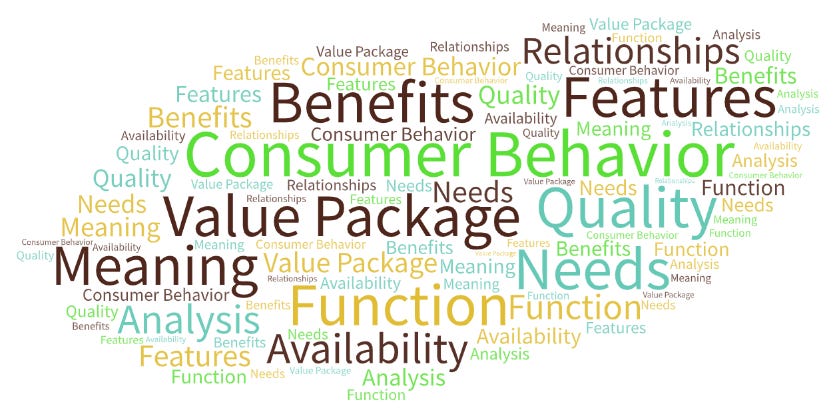
The consensus on how to label the value a product or service brings to consumer’s is the Value Package. Simply put, these are a combination of attributes that determines a product’s value. This value comes directly from the consumers of the products, not the company that made/provides it. Categorized as ‘function + features + benefits.’
Function:
The inherent purpose for the product. For example, a car provides an option to go from point a to point b and restaurants provide meals to make you satisfied.
Features:
Additional attributes which contribute to the products usefulness and enhance experiences. For example, if a car has a convertible roof and air conditioning, or if a restaurant has live music.
Benefits:
The advantages your purchase makes you feel. A lot of times, benefits lead to a direct effect on status, image, and a reputation. For example, a car would make somebody feel independent, or a nice Rolex makes somebody feel rich.
These three attributes are what directly lead to a product’s value, determined by what customers are willing to pay. The beauty about Apple being priced so high or a Rolls Royce being an expensive car is because the value package determined by their consumers allows it to be. People give into FOMO (fear of missing out) and buy depreciating assets such as the new phones or certain expensive cars. There is nothing wrong that, that is the beauty of a free market. Consumers decide what they want to pay for a product, the rest falls into place.
Different ways to create value through marketing:
Amongst other ways to market a product, I have decided to gather up three different orientations companies have successfully marketed their products in the past.
Availability
Otherwise known as the ‘production orientation’, it is mostly seen by automobile companies (Ford Motors), and fast-food restaurants (McDonald’s). This is because they focus on the efficiency of which they produce their products. They can mass produce their products quickly and efficiently and take pride whilst doing so.
If you are a fast-food franchise owner, you are not looking to make the highest quality burgers, but rather the most burgers to supply for the demand that’s there. If you have seen the movie ‘The Franchise’ on Netflix, you see the behind the scenes on how Ray Kroc was able to revolutionize fast food restaurants.
Quality
The product orientation. These are businesses that are centered more around creating products with the highest quality and most innovative features. By investing a lot into research and development, the product is at its best performance.
For example, Sony or Apple could be described as a product orientation as they focus on creating the most innovative products. Specifically, in the 2019 fiscal year, Sony spent about $4.6 billion USD on research and development expenses. In 2020, Apple one-upped everybody by spending about $18.75 billion USD on research and development. These are billions going directly into improving already existing (or even new) products.
Meet Unmet Needs
Known as the ‘marketing orientation’, the whole premise is that the center of the universe is any given customer. The immediate assumption is that consumers have unmet needs, and the company will do whatever it can to meet those needs.
A great example of a marketing orientated company is Amazon. There have been thousands of updates and changes to their website that directly effect the desires expressed by their consumers. Amazon obtains these desires by having top of the line customer relationship and communication. It feels as if Amazon cares that your package gets to you and that you are satisfied post-purchase.
Most companies use multiple orientations at once, and as a consumer it’s the best possibility. You want to use a product that is produced quickly, with high quality, and feel as if the company made it just for you.
It is up to companies and their administrations to position themselves and their marketing styles. Whether you’re at a start-up or at a major company, the fundamentals in marketing and the consumer mindset remains the same. It is just a matter of knowing your consumer and catering to what they value.
That is all for newsletter #2, newsletter #3 will be released next Wednesday morning. Again, all feedback and shares are appreciated, and let’s finish this week with a bang!